











High-temperature resistant silicone is used in the field of industrial manufacturing.
I. Extreme High-Temperature Sealing & Insulation Scenarios: Industrial Furnaces, Hot Presses
High-temperature resistant silicone
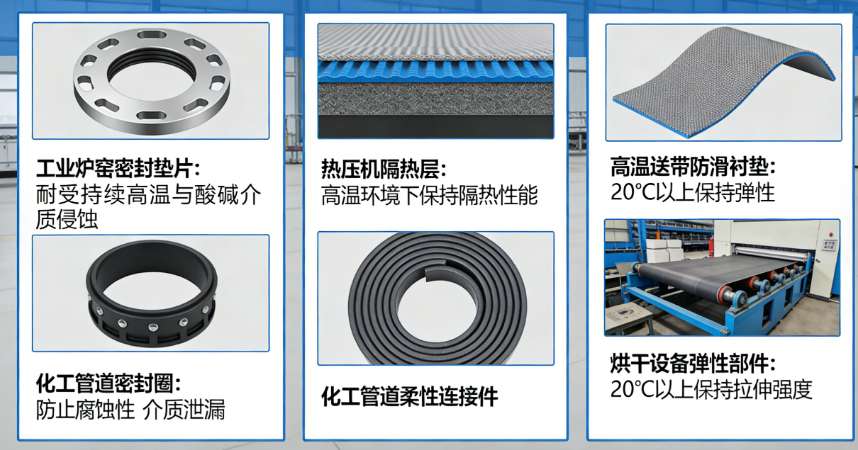
1. Sealing Gasket for Industrial Furnaces
Core Value: Withstands continuous high temperatures of 200℃–300℃ (special formula up to 350℃ for short periods). It does not crack or deform under thermal cycling, blocks high-temperature flue gas leakage and cold air infiltration for a long time, ensuring heating efficiency and eliminating safety hazards.
Performance Support: Excellent high-temperature dimensional stability, compression set ≤25% (national standard premium grade), resistant to mild corrosion by sulfides and oxides.
2. Thermal Insulation Layer for Hot Presses
Core Value: Provides both elastic cushioning and thermal insulation. Absorbs mechanical impact to protect components, reduces heat conduction to the frame and lowers energy consumption. Maintains stable resilience above 200℃ without permanent collapse.
Performance Support: High resilience ≥70%, thermal conductivity ≤0.3W/(m·K), withstands dozens of tons of surface pressure.
II. Chemical Corrosion Conditions: Flexible Connectors & Sealing Rings for Chemical Pipes
1. Flexible Connector for Chemical Pipes
Core Value: Flexibly compensates for installation tolerances and operational vibration. Resists long-term erosion by media such as dilute sulfuric acid, sodium hydroxide and salt solutions, withstands medium temperatures of 150℃–200℃, fundamentally eliminates corrosive medium leakage and avoids equipment corrosion and safety accidents.
Performance Support: Resistant to chemical media (volume change ≤5% after 72h immersion in 20% acid/alkali solution), oil-resistant and resistant to non-strong organic solvents, service life of 5–8 years in outdoor/chemical environments.
2. Sealing Ring for Chemical Pipes
Core Value: Precisely fits sealing surfaces and maintains excellent sealing performance under high-temperature, corrosive and pressurized conditions. Specially designed for pipelines conveying corrosive high-temperature media, solving the problems of swelling, aging and leakage of ordinary rubber.
Performance Support: Precision molding (tolerance ≤±0.05mm), Shore hardness 60–80° optional, no leakage under 0.6–1.6MPa pressure.
III. High-Temperature Dynamic Conditions: High-Temperature Conveyor Belts, Drying Equipment
1. Anti-Slip Pad for High-Temperature Conveyor Belts
Core Value: Maintains excellent elasticity and friction coefficient at 200℃–250℃, effectively preventing high-temperature materials from sliding off. Resists material impact and friction, not easy to damage or fall off, extending the service life of the conveyor belt.
Performance Support: Tensile strength ≥5MPa at high temperature, elongation at break ≥300%, Shore A hardness 50–70° (balanced elasticity and wear resistance), no obvious wear after millions of cyclic friction tests.
2. Elastic Components for Drying Equipment
Core Value: Maintains flexible movement without hardening or brittle fracture in high-temperature environments above 200℃. Resists erosion by hot air, steam and mild drying additives, ensuring continuous and stable operation.
Performance Support: Elastic retention ≥80% at 200℃, performance degradation ≤10% after 72h aging in 120℃ steam, ozone aging resistant (suitable for hot air circulation conditions).