




Consumer Electronics Empowered TCF (Industrial Manufacturing Scenario) Innovative Solution
2026/03/10
0
Core Innovations
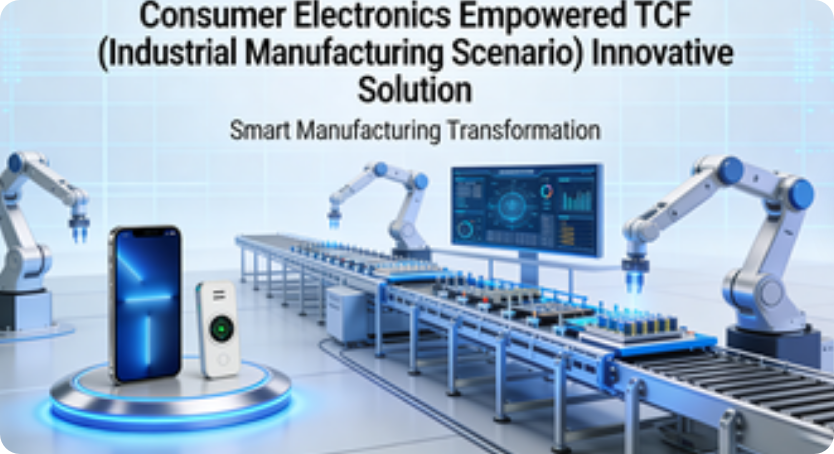
Industrial Manufacturing Scenario
Adopting an integrated process of “Agricultural and Forestry Waste Lignin Purification & Modification + ORNL Carbon Fiber Precursor Technology + Roll-to-Roll CVD Coating”, this solution uses lignin extracted from agricultural and forestry wastes such as corn stover and wheat bran as the core raw material. Carbon-based conductive precursors are prepared through deashing and cross-linking modification, followed by roll-to-roll CVD deposition to form transparent conductive films. This breakthrough replaces ITO materials relying on scarce indium resources, achieving dual breakthroughs in environmental protection and low cost.
Differentiating Advantages
- Extreme Cost Advantage: Using lignin extracted from agricultural and forestry wastes as raw materials, which are widely available and priced at only 1/5 of indium raw materials. Combined with roll-to-roll mass production, the overall raw material cost is 60% lower than traditional ITO films, perfectly matching cost-sensitive consumer electronic products including mid-to-low-end smartphones, tablets and e-readers.
- Low-Carbon & Eco-Friendly Features: As a natural biomass raw material, lignin enables the whole production process to reduce carbon emissions by 40% compared with ITO films, and the waste is biodegradable. It complies with the “Dual Carbon” policy and the environmental upgrade trend of consumer electronics, helping brands build green product labels.
- Qualified & Adaptable Performance: Light transmittance ≥ 88%, haze < 1.2%, with visual effect close to ITO films without affecting device display experience; sheet resistance ≤ 20 Ω/sq, meeting core functional requirements such as touch control and display driving. With certain flexibility, the resistance change rate after 500 times of 180° bending adapts to daily usage scenarios of consumer electronics.
Technical Support
- Raw Material Modification Technology: Lignin is purified via “alkali dissolution-acid precipitation + microwave-assisted deashing” process, reducing ash content (mainly SiO₂, CaO) to < 0.5%. Formaldehyde-phenol cross-linking modification further improves thermal stability, enabling lignin precursors to form a continuous and dense carbon conductive network during CVD.
- Low-Cost Mass Production Process: Introducing ORNL low-cost carbon fiber precursor technology, lignin is blended with a small amount of polyacrylonitrile (PAN), lowering the carbonization film-forming temperature to 800℃ (200℃ lower than traditional carbon fiber) to reduce energy consumption. Equipped with roll-to-roll CVD coating, it realizes continuous production of wide-width (≤1.5m) films, cutting mass production cost by 30% compared with batch production, with yield reaching over 92%.
- Conductive Performance Optimization: Methane/hydrogen mixture is introduced during CVD, and plasma-assisted deposition forms a graphene-like carbon conductive layer with carrier mobility up to 150 cm²/V·s. Combined with laser etching to fine-tune conductive paths, sheet resistance is stably controlled within 20 Ω/sq while ensuring high light transmittance.
Dongguan Yusheng Technology Co., Ltd.
Specialized in R&D, development and production of transparent conductive films and supporting adhesives.
Contact: zhengzhen@nqrubber.com
Mobile: +86-13243809168Zheng