











Functions and Technical Requirements of PDMS Membranes in Piezoresistive/Variable-Pressure Sensors
2026/09/03
0
In variable-pressure sensors (capacitive and piezoresistive flexible pressure sensors), the PDMS membrane serves as the core elastic sensing and dielectric functional layer. It directly determines the sensor’s sensitivity, linearity, response speed and cycling stability. Different from ordinary general-purpose PDMS films, it needs to meet special operating conditions for mechano-electrical conversion.
PDMS Membranes in Piezoresistive/Variable-Pressure Sensors
I. Core Functions of PDMS Membranes in Variable-Pressure Sensors
1. Elastic Deformation Sensing (Core Function)
Featuring low modulus, high elasticity and recoverable deformation, the PDMS membrane acts as the core for mechanical response of the sensor. When external pressure is applied, the membrane undergoes uniform and reversible compression/depression deformation. It quickly rebounds and resets once pressure is removed, precisely converting macroscopic pressure signals into microscopic deformation signals and laying the foundation for subsequent mechano-electrical conversion. It is the core medium for pressure measurement of the sensor.
2. Dielectric Layer Function (Exclusive for Capacitive Sensors)
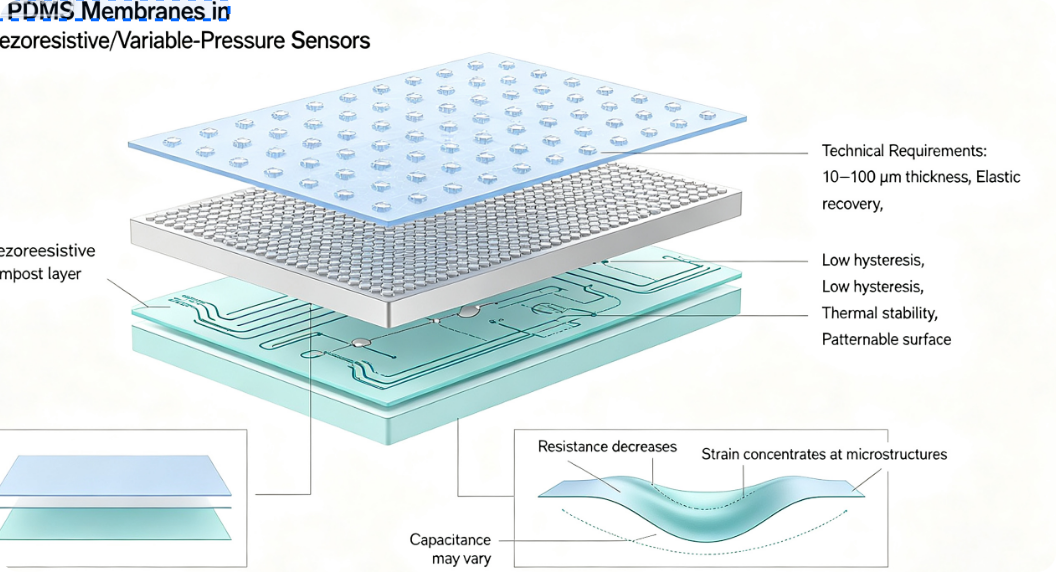
Pure PDMS is an excellent insulating medium, sandwiched between upper and lower electrodes as the sensing dielectric layer. Upon compressive deformation, membrane thickness decreases and dielectric contact area changes, leading to regular variation in the sensor’s capacitance. The magnitude of pressure can be accurately correlated with capacitance variation to realize conversion from pressure signals to electrical signals. Fabrication of porous or microstructured PDMS membranes can optimize dielectric properties and greatly improve sensing sensitivity.
3. Conductive Matrix and Stress Transmission (Exclusive for Piezoresistive Sensors)
Composite PDMS membranes doped with conductive fillers such as carbon nanotubes, graphene and silver nanowires work as piezoresistive sensing functional layers. Under pressure, the PDMS matrix deforms, which alters contact points and conductive pathway density inside the internal conductive network and induces regular resistance variation for pressure sensing. Meanwhile, the PDMS matrix transmits stress uniformly to prevent sensing distortion caused by localized stress concentration.
4. Protection, Encapsulation and Pressure Stabilization
PDMS has strong chemical inertness, moisture resistance and corrosion resistance. It can be used as the surface encapsulation film of sensors to isolate interference from water vapor, dust and mild acid/alkali environments and protect internal electrodes and sensing structures. It also buffers instantaneous impact pressure, improves operational stability and service life of sensors, and adapts to complex scenarios including wearable devices, human body monitoring and flexible touch control.
II. Special Technical Requirements for PDMS Membranes for Variable-Pressure Sensors
1. Mechanical Performance Requirements (Most Critical)
First, controllable and stable modulus: low Young’s modulus of 0.1–1.5 MPa is suitable for common sensing conditions to facilitate easy deformation and high sensitivity under low pressure, while avoiding creep and hysteresis induced by excessively low modulus to achieve linear response over a wide pressure range. Second, excellent deformation reversibility: no plastic deformation occurs during cyclic compression and rebound, with small hysteresis error and no fatigue failure after long-term repeated stress, satisfying high-frequency and long-term measurement requirements of sensors. Third, uniform mechanical properties across the membrane: consistent hardness and elasticity over the whole film without local softness/hardness deviation, preventing sensing signal drift caused by uneven deformation under force.
2. Dimensional and Structural Precision Requirements
Uniform and controllable membrane thickness: thickness of conventional sensing membranes is controlled at 20–200 μm with thickness error within ±5 μm. Uneven thickness directly causes deformation difference across regions and poor sensing consistency. The membrane shall be free of pinholes, bubbles, cracks and other defects, which may trigger dielectric leakage, stress concentration and local failure and drastically reduce sensor accuracy and stability. Microstructures (pyramidal, porous, wrinkled structures) can be fabricated as required, with precise regulation of pore size and bump array dimensions to meet sensing demands of high sensitivity and wide measurement range.
3. Electrical and Insulation Performance Requirements
Pure PDMS dielectric layers shall feature high insulation, low dielectric loss and stable dielectric constant, ensuring capacitance signal variation is solely induced by pressure deformation and eliminating interference from electric leakage and stray capacitance. Composite conductive PDMS membranes require uniform dispersion of conductive fillers without agglomeration or precipitation, guaranteeing good linearity and high repeatability of pressure-resistance response. The membrane surface shall be flat and dense without protruding impurities to avoid abnormal contact resistance arising from poor electrode adhesion.
4. Material Process and Stability Requirements
Precise mixing ratio: the curing ratio of common Sylgard 184 is strictly controlled at 10:1 to ensure uniform crosslinking and prevent excessive softness with creep or brittleness prone to cracking. Low small-molecule precipitation: thorough curing to avoid electrode contamination and degradation of sensing performance caused by migration and precipitation of small molecules in later service. Excellent temperature stability: no obvious fluctuation in modulus, deformation and dielectric properties within normal operating temperature range, adapting to room temperature and minor temperature variation conditions. Controllable surface properties: plasma modification can realize hydrophilic bonding to achieve tight adhesion with electrodes and substrates and prevent delamination.
5. Environmental Adaptability Requirements
Good moisture resistance and weather resistance, waterproof and damp-proof, suitable for wearable human devices and general indoor and outdoor application scenarios. Outstanding biocompatibility without cytotoxicity, meeting application demands of flexible medical sensing and human tactile detection. Resistance to mild friction, maintaining stable structure and performance after long-term contact wear.