











UV-Condensation Silicone vs. Acid-Curing Sealant for PDMS Membrane Bonding
UV-Condensation Silicone vs. Acid-Curing Sealant for PDMS Membrane Bonding
1. Curing Mechanisms and Fundamental Properties of the Two Adhesives
1. Custom UV Condensation Silicone (UV + Moisture Dual Cure)
After curing, its molecular structure is chemically similar to PDMS. Its elastic modulus and tensile ductility closely match those of PDMS membranes, making it suitable for dynamic flexible applications under repeated bending and stretching.
2. Acid-Curing Sealant (One-Part Moisture-Curing RTV)
2. Distinction of Core Performance and Applicable Scenarios
UV Condensation Silicone (Preferred for Precision PDMS Bonding)
It supports homogeneous PDMS-to-PDMS bonding and heterogeneous bonding between PDMS and glass, PET, ITO flexible substrates, precision metallic substrates. Widely applied in microfluidic chip packaging, flexible electronic skin, laminated optically clear films, wearable medical devices and other fields.
Acid-Curing Sealant (Only for General Static Sealing)
3. Full Comparison of Key Parameters
| Comparison Item | UV Condensation Silicone (Dual-Cure) | Acid-Curing Sealant (RTV) |
|---|---|---|
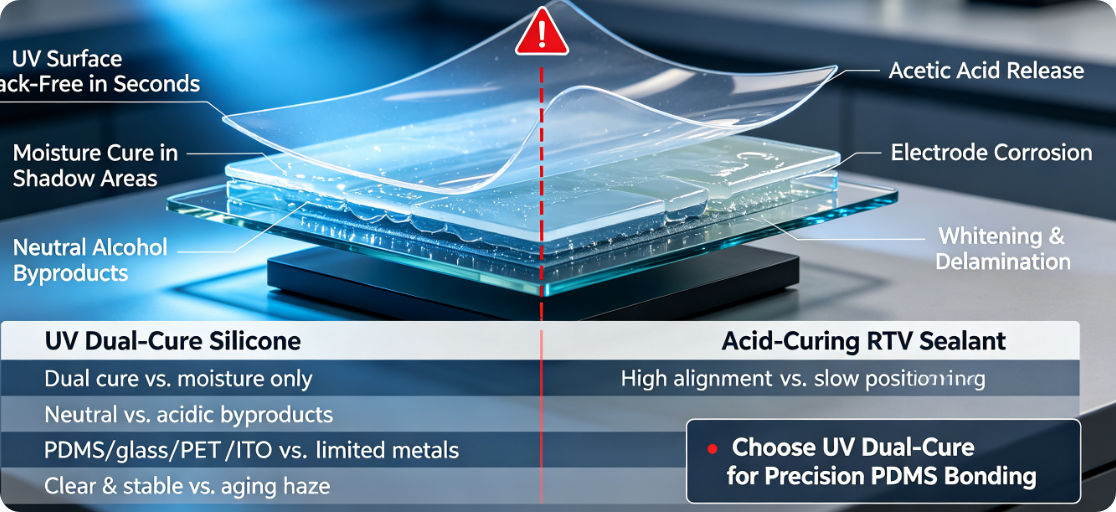
| Curing Mechanism | Second-scale UV surface fixation + deep-layer moisture curing | Single ambient moisture curing, slow cure from surface to bulk |
| Curing Byproducts | Alcohols (neutral, non-corrosive, odorless) | Acetic acid (acidic, highly corrosive, strong irritating odor) |
| Positioning Efficiency | UV locks alignment within seconds, no slippage, mass-production compatible | Surface dry: 5–15 min; prone to misalignment before full cure |
| Substrate Compatibility | Compatible with PDMS, glass, PET, ITO and various metals | Only compatible with glass and ordinary silicone films; corrodes most metals/coatings |
| Optical Performance | High clarity, no yellowing or haze; suitable for optical systems | Prone to slight whitening; suffers transparency degradation upon aging |
| Flexibility Matching | Modulus close to PDMS; withstands repeated bending and stretching | Relatively rigid after cure; cracking and delamination under deformation |
| Application Grade | Precision devices, scientific research, industrial mass production | General static sealing, non-precision structural fixation |
4. Practical Operation Guidelines for PDMS Membrane Bonding
Notes for UV Condensation Silicone
- Pre-treat PDMS membranes before bonding: clean and remove dust with anhydrous ethanol. For high-precision applications, plasma or corona treatment is recommended to greatly improve interfacial adhesion and prevent peeling in service.
- Apply thin and uniform adhesive layers. Control thickness at 5–20 μm. Avoid thick glue or glue accumulation, which blocks light in deep regions and causes incomplete curing and bubble formation.
- Ensure an effective light transmission path for UV irradiation. Exposed areas must be reserved on bonded surfaces. Fully shaded dead zones require extended ambient moisture curing time to achieve complete crosslinking.
- Under low humidity (relative humidity <40%), deep-layer curing slows significantly. Moderately raise ambient humidity or extend curing time to avoid uncured interior and bonding failure.
- Store one-part adhesive in sealed, light-proof packaging to prevent premature photo-initiated curing. Use promptly after opening to avoid adhesive degradation.
Notes for Acid-Curing Sealant
- Never use on precision functional PDMS devices, including microfluidic chips, biological experimental devices, flexible sensors with electrodes/coatings and optically transparent components, to prevent corrosion, contamination and performance failure.
- Operations require adequate ventilation. Do not use in confined spaces. Volatile acetic acid fumes are irritating to human bodies and may corrode nearby precision equipment.
- Forbid contact with copper, aluminum, galvanized parts, ITO conductive films and precision metallic components. Even short-term lamination can trigger oxidation, corrosion and electrical malfunction.
- When thin-coating PDMS membranes, avoid rapid skin formation on the surface which blocks moisture penetration into the bulk, resulting in uncured interior, bubbling and interfacial delamination. Maintain ventilation during curing after dispensing.
- Not suitable for precision working conditions with long-term water immersion, constant high humidity. Acidic residues continuously degrade bonding interfaces and accelerate device aging.
- Seal leftover adhesive immediately after use. Only remove surface skin formed at the nozzle before reuse. Do not pour used adhesive back into the original container to avoid contaminating the whole batch.
5. Quick Material Selection Summary
For low-cost static sealing of ordinary PDMS membranes with no precision functions, metallic substrates or subsequent experimental characterization: acid-curing sealant may be adopted.