










Technical Application of Conductive Fabrics in Robots
2026/06/22
0
I. Core Technical Principles
Shielding Mechanism
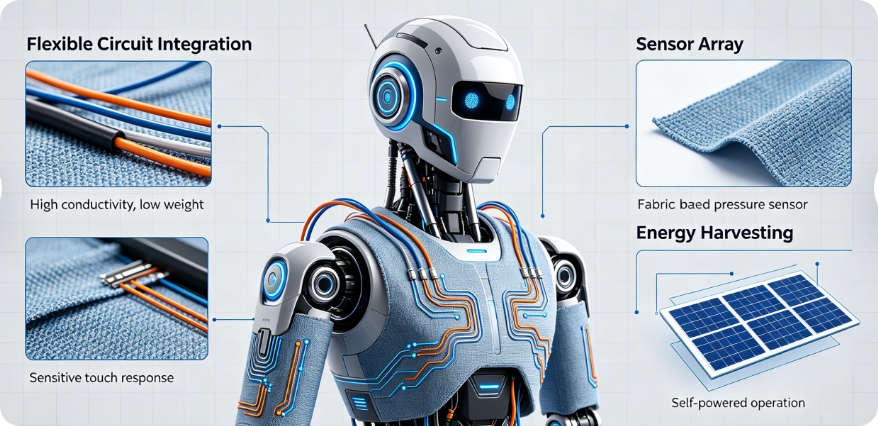
Conductive Fabrics in Robots
Conductive fabrics (e.g., silver fiber cloth) form closed electromagnetic loops via the conductivity of metallic fibers, attenuating electromagnetic waves through dual effects of reflection and absorption:
- Reflection: Metallic fibers (silver / copper-nickel) create impedance discontinuities for electromagnetic waves in the 200 kHz–2.7 GHz frequency band, achieving a reflectivity of over 99% (a shielding effectiveness of 50 dB corresponds to a transmittance of only 0.001%).
- Absorption: Capacitance effects between fibers dissipate high-frequency electromagnetic energy, especially targeting motor PWM harmonics (fundamental waves of 20–50 kHz extending above 30 MHz) and 2.4 GHz Wi-Fi signals.
Frequency Band Adaptability
The 200 kHz–2.7 GHz frequency range covered by this solution precisely matches the main interference sources of household robots:
- Motor drive interference: PWM switching noise from brushless motors (harmonics spanning 30 MHz–1 GHz)
- Wireless module interference: 2.4 GHz Wi-Fi (the mainstream communication band for robots) and Bluetooth (2.4–2.48 GHz)
It complies with shielding requirements for the 30 MHz–3 GHz band specified in standards including IEC 61000-6-3 and GB/T 18663.3 (Class 2 limit ≥ 20 dB, with a 30 dB performance margin reserved in this solution).
II. Verification of Core Advantages (vs. Conventional Metal Shielding)
| Performance Indicator | Flexible Conductive Fabric (Silver Fiber Cloth) | Conventional Metal Shielding (Aluminum Foil / Sheet Metal) | Technical Breakthrough |
|---|---|---|---|
| Shielding Effectiveness | 50 dB across 200 kHz–2.7 GHz; 70 dB+ via multi-layer lamination | 60–120 dB (poor high-frequency conformability) | Balances flexibility and uniform high-frequency shielding |
| Weight | 63–500 g/m² (typical silver fiber cloth: 63 g/m²) | Over 2000 g/m² | Over 40% weight reduction, alleviating robot endurance load |
| Conformability | Seamlessly fits complex curved surfaces (e.g., robot joints, curved housings); simple cutting and sewing processes | Rigid structures incompatible with curved surfaces; requires welding / bolt fastening | Simplifies assembly and lowers structural design complexity |
| Impact Resistance | Textile substrate cushions impacts; silver fiber elongation at break ≥ 15% | Prone to deformation and fracture | Maintains stable shielding during robot drops or collisions |
| Material Cost | $50–300/m² (silver fiber cloth approx. $72/m²) | $20–150/m² | Lower overall cost (30% savings on processing & assembly labor) |
III. Typical Application Scenarios
Robot Vacuum Cleaners
Pain Points Addressed: Electromagnetic radiation from motors interferes with LiDAR and visual navigation (interference in the 30 MHz–1 GHz band causes path planning errors).
Implementation Solution: Fully line the inner housing with plain-woven silver fiber cloth (plain weave improves uniformity of high-frequency shielding). Seal all seams with conductive adhesive to eliminate shielding gaps.
Companion Robots
Pain Points Addressed: Electromagnetic coupling between multiple sensors (tactile / visual) and Wi-Fi modules, plus safety risks during human-machine contact.
Implementation Solution: Adopt silver-cotton blended conductive fabric (surface resistance: 1.2 Ω/inch) with both shielding performance and biocompatibility (ECO-TEX certified). The antibacterial property of silver fibers also inhibits bacterial growth on contact surfaces.
IV. Key Points for Commercialization & Mass Deployment
Performance Optimization
- Multi-layer Lamination: Single-layer silver fiber cloth delivers around 35 dB shielding effectiveness; stable 50 dB is achieved with two stacked layers (total thickness ≤ 0.2 mm).
- Edge Treatment: Laser cutting prevents fiber shedding; tin-plated edges reduce contact impedance.
Process Compatibility
- Integrated molding with robot housings: Direct lamination onto ABS/PC housings via conductive pressure-sensitive adhesive (cPSA) double-sided tape, boosting assembly efficiency by 40%.
- IP Rating Compatibility: Laminated PTFE film on the surface delivers water and dust resistance up to IP54 without compromising shielding performance.