











Silicone Mask + Makeup swap face
2025/12/28
0
I. Core Logic of Swap face with Silicone Masks: The Underlying Support for Moving from “Superficial Resemblance” to “Spiritual Resemblance”
Silicone Mask + Makeup swap face
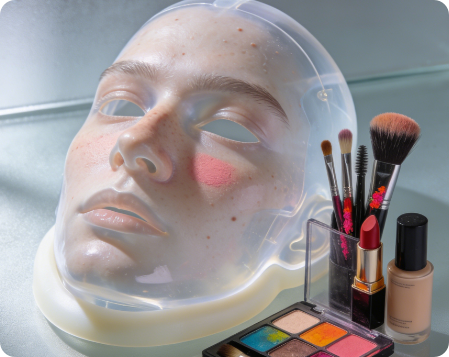
Silicone masks have become the core carrier for swap face thanks to their highly simulated materials and precise contour replication. The key to their face-swapping capability lies in material compatibility and detail restoration. Medical-grade liquid silicone boasts softness, elasticity and light transmittance close to human skin, which can perfectly fit facial contours and avoid the stiffness of traditional masks. Meanwhile, replicating the bone structure and muscle texture of the target face (such as the protrusion of the apple muscles and the depth of nasolabial folds) through 3D scanning technology lays the foundation for “static superficial resemblance” — this is the first and most critical physical support for face swapping.
However, silicone masks alone cannot achieve “complete face swapping”. The connection between the mask edges and the wearer’s own skin, as well as the naturalness of dynamic facial expressions, require makeup techniques to achieve “seamless integration”. The synergy logic between the two is as follows: silicone masks are responsible for “replicating the target face shape and basic features”, while makeup serves to “eliminate boundary lines, enhance the authenticity of details, and adapt to dynamic scenarios”, resulting in a face-swapping effect where 1+1 is greater than 2.
II. Key Steps to Achieve Complete swap Face: Collaborative Operation of Silicone Masks and Makeup
1. Preparations: Core Parameters of Customized Silicone Masks
To achieve “complete swap face “, generic masks will not suffice; customized masks must meet the following requirements:
- Contour Precision: 3D scanning of the target face ensures that the error margin of bone contours such as the brow ridges, cheekbones and jawline is ≤ 1mm, avoiding flaws like “a face that looks one size larger” or “poor fit”.
- Detail Replication: Restore the eyebrow direction, eye socket depth, nasal alar curvature of the target face, and even subtle pore textures (achievable through mold micro-engraving).
- Material Compatibility: Select breathable silicone (with added air vents) to prevent skin overheating and mask fogging during prolonged wear, while ensuring the mask can deform synchronously with minor facial muscle movements (such as smiling or frowning).
2. Makeup Integration: Eliminating Boundaries and Enhancing Authenticity
This is the core link of “complete face swapping”, focusing on solving two major issues: the connection between the mask and the wearer’s own skin and the naturalness of dynamic expressions:
- Edge Transition Makeup: A 0.5–1cm “blending zone” is reserved at the mask edges (usually along the hairline, temples, jawline and neck). Concealer and foundation matching the wearer’s skin tone are layered and blended to eliminate the “discontinuity between the mask and skin”. Wig pieces or hairline powder can be used at the hairline to cover the connection traces of the mask edges.
- Detail Enhancement Makeup: Based on the target face’s features, makeup techniques are used to add “dynamic details” to the mask — for example, if the target has under-eye bags, a pearlescent pen can be used to outline the area below the mask’s eyes; if the target has dimples when smiling, contour powder can be applied to deepen the corresponding positions on the mask. Meanwhile, setting spray is used to fix the makeup, preventing it from falling off the mask surface due to sweating or friction.
- Expression Adaptation Makeup: Although silicone masks can simulate basic facial contours, the wrinkle effect of dynamic expressions (such as talking or smiling) needs to be enhanced through makeup. Light brown eyeshadow or contour cream is gently applied to the corners of the mouth, eyes and sides of the nose on the mask to create “dynamic wrinkles”, making expressions more natural and avoiding the stiffness of a “mask face”.
3. Scene Adaptation: Optimization Tips for Face Swapping in Different Scenarios
- Daily Close-Range Scenarios (e.g., socializing, short meetings): Focus on optimizing skin tone matching and detail authenticity. Choose foundation that matches the wearer’s skin tone and type (moisturizing foundation for dry skin, oil-controlling foundation for oily skin) to prevent the mask surface from reflecting light. Makeup should be applied synchronously to exposed areas such as the hands and neck to ensure uniform overall skin tone.
- Stage/Film Scenarios (long-distance viewing, under lighting): Facial contour makeup can be appropriately intensified (e.g., using contour powder to highlight cheekbones and jawline) to make the face-swapping effect more three-dimensional under lights. Meanwhile, professional waterproof and sweat-proof makeup products should be selected to prevent makeup from melting or reflecting light under illumination.
- Dynamic Shooting Scenarios (e.g., videos, short films): Test the “movement range” of the mask in advance to ensure it does not shift during actions such as talking or turning the head. Medical double-sided tape (to avoid skin irritation) can be pasted on the inner edges of the mask to enhance fit. In terms of makeup, focus on “dynamic details” — for example, lip gloss can be applied to the mask’s lip area to simulate the natural luster of real lips.
III. Notes: Core Principles of Safety and Compliance
- Safety First: Choose medical-grade silicone masks produced by regular manufacturers to avoid skin irritation caused by inferior silicone. Do not wear the mask for too long (it is recommended that single wear time does not exceed 4 hours). Clean the mask regularly (wipe the surface with mild makeup remover and let it air dry) to prevent bacterial growth.
- Compliant Use: Face-swapping technology can only be applied in legitimate scenarios (such as film and television shooting, stage performances, and makeup art creation). It is strictly prohibited for illegal and irregular activities such as fraud, rumor-mongering, and infringement of others’ portrait rights. Relevant provisions on portrait rights and personality rights in the Civil Code must be complied with.
- Emergency Handling: If skin itching or redness occurs during wearing, remove the mask immediately, clean the face with warm water, and apply anti-allergy ointment if necessary. If the mask edges are damaged, repair or replace them in a timely manner to avoid skin scratches from sharp edges.