








Low Refractive Index Optical Adhesive
2026/04/23
0
Optical low-refractive-index UV adhesive generally refers to a UV-curable transparent adhesive with a refractive index n = 1.35–1.42 (@589 nm). Its core function is to reduce interfacial reflection and optical loss, and it is widely used for optical path bonding and optical component fixation.
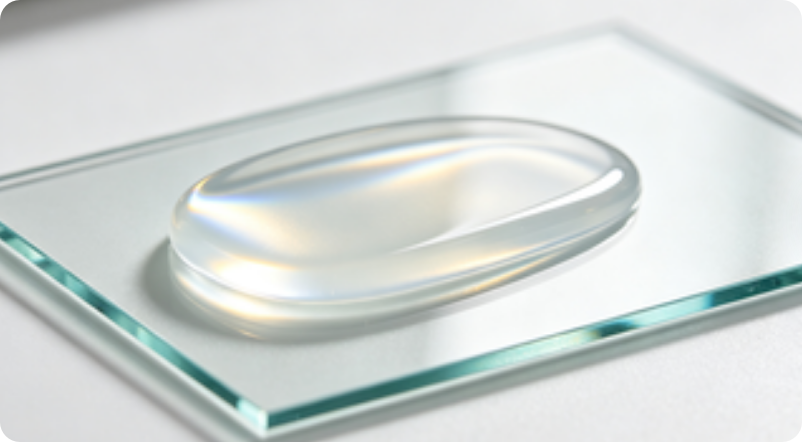
Low Refractive Index Optical Adhesive
I. Core Features (Low Refractive Index + High Transmittance + Fast Curing)
- Low refractive index: Typically 1.36–1.40, commonly ranging from 1.36 to 1.41, lower than conventional optical UV adhesives (1.45–1.55).
- High light transmittance / Low haze: Visible light transmittance ≥ 95%, haze < 0.2%, with clear cured appearance and no yellowing.
- Rapid UV curing: Cures within several seconds to tens of seconds under 365 nm ultraviolet light; partial grades support deep curing with nitrogen protection and heating assistance.
- Low stress / Low shrinkage: Shrinkage rate < 3% with low modulus, which minimizes stress birefringence and micro-bending loss.
- Environmental resistance: Stable performance from -40℃ to +80℃, featuring moisture resistance and thermal shock resistance, suitable for harsh working conditions.
II. Common Refractive Index Range & Application Directions (@589 nm)
| Refractive Index (n) | Characteristics & Applications |
|---|---|
| 1.36–1.37 | Fiber lasers, Cladding Power Strippers (CPS), ultra-low reflection scenarios |
| 1.39 | Lenses, display screens, AR/VR lenses, general low-refractive-index optical bonding |
| 1.409 | Glass-to-glass bonding, optical communication devices (FA/PLC), silicon photonics packaging |
| 1.42 | Low viscosity for micro-nano optical fibers, waveguide coupling and capillary filling scenarios |
III. Major Application Scenarios
- Optical Communication & Optical Fiber: Fixation of fiber fusion splices, combiners, splitters, Fiber Arrays (FA), and PLC planar waveguides. Low-RI adhesives (n≈1.36) enable cladding light stripping and stray light isolation.
- Display & Optical Films: Lamination bonding of LCD/OLED layers, lamination of TAC/PET protective films, and gradient refractive index design of Anti-Reflective (AR) films to reduce interfacial reflection and enhance contrast.
- Lenses & Precision Optics: Bonding of mobile phone lenses, vehicle-mounted lenses, AR/VR lenses, prisms and beam splitters. Refractive index matching (1.39–1.41) eliminates air layer reflection and improves imaging clarity.
- Micro-Nano Optics: Microfluidic chips, optical waveguides, photonic crystals and optical sensors. Low viscosity and low refractive index facilitate filling of tiny gaps and reduce optical loss.
IV. Material Mechanism (How to Achieve Low Refractive Index)
- Conventional UV adhesives: Dominated by acrylate/epoxy systems, with a refractive index of 1.45–1.55.
- Low-RI UV adhesives: Adopt fluorine-modified acrylate/epoxy systems. The introduction of low-polarizability C–F bonds reduces the refractive index to 1.36–1.42 while maintaining high transparency and UV curing performance.
V. Key Selection Guidelines
- Refractive Index Matching: The adhesive RI shall be slightly lower than that of the bonded substrate (e.g., fused silica glass n≈1.44, matched with adhesives of n=1.39–1.42).
- Viscosity Selection: Low viscosity (15–50 cps) for micro-gap and capillary filling; medium viscosity (100–500 cps) for large-area bonding and fluctuating gaps.
- Curing Conditions: Compatible with 365 nm LED light sources with a curing energy of 2–5 J/cm². Nitrogen protection (oxygen inhibition) and heating (60–120℃) are required for thick glue layers and deep curing.
- Reliability Requirements: Focus on temperature resistance, moisture resistance and Coefficient of Thermal Expansion (CTE) to ensure compatibility with device operating conditions.
VI. Standard Operating Process
Substrate Cleaning → Dispensing/Coating → Lamination → 365 nm UV Curing (5–30 s) → (Optional) Thermal Post-Curing (80℃ / 1–3 h) → Testing of Light Transmittance / Reflectivity / Adhesion.