











Innovative TCF Solution Empowering Architecture / BIPV Scenarios (Industrial Manufacturing Scenario)
Core Innovation
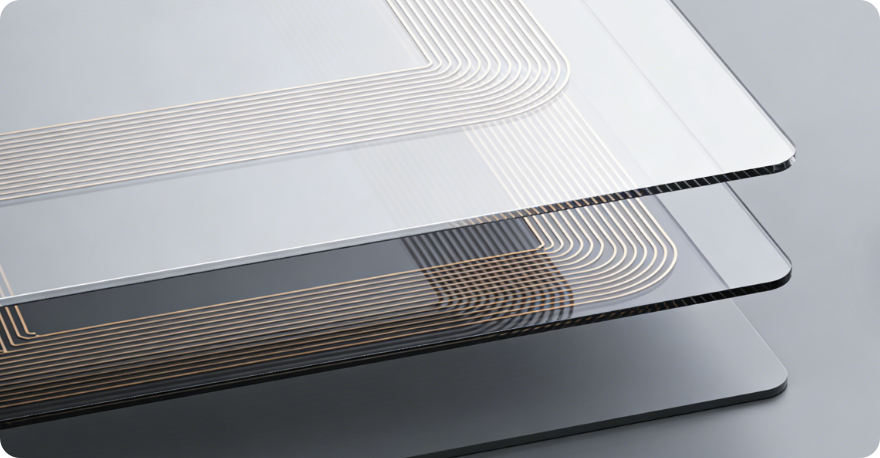
High-transmittance TCO film + Crystal-plane optimized perovskite photovoltaic layer + Smart electrochromic thermal control layer,
which breakthroughly achieves three core functions:
high-efficiency power generation + dynamic dimming + constant-temperature thermal insulation.
- TCO film: visible light transmittance ≥ 85%
- Perovskite layer: enhanced thermal stability via MACl-induced (100) crystal plane orientation
- Electrochromic layer: response time ≤ 3 seconds
Differentiation Advantages
-
Resolves core BIPV contradiction:
Solves the industry pain point of traditional BIPV where “power generation efficiency and architectural daylighting cannot be achieved simultaneously”.
Applied in large public buildings such as Guangzhou Baiyun Railway Station, it can cover large-area transparent areas including roofs and curtain walls.
Annual power generation is 15% higher than traditional crystalline silicon BIPV, without compromising natural daylighting inside buildings.
-
Ultimate energy efficiency optimization:
In summer, the electrochromic layer adjusts transmittance to 30%. Combined with the high thermal conductivity of (100)-oriented perovskite (1.068 W·m⁻¹·K⁻¹), heat dissipation is accelerated, reducing building cooling energy consumption by 30%.
In winter, high transmittance is maintained while heat loss is reduced through the thermal insulation property of the composite film, resulting in remarkable overall energy consumption optimization.
-
Ultra-long stable operation:
After crystal-plane engineering optimization, the perovskite layer retains >90% performance after 1100 hours of continuous illumination at 85℃.
It overcomes the bottleneck of insufficient stability in traditional perovskite modules, matches the 25-year service life of buildings, and requires no frequent maintenance.
Technical Support
-
Coating Process:
Adopts in-line CVD coating, equipped with a micro-positive pressure laminar flow reaction chamber and multi-nozzle zoned gas injection system, realizing uniform deposition on 1.5m×1.8m large-area substrates.
Film thickness non-uniformity and haze are strictly controlled below 2%, ensuring a balance between power generation efficiency and light transmittance.
-
Material Optimization:
The perovskite layer forms a (100) crystal-plane-dominated structure induced by MACl.
Grain size increases from 390 nm to 1800 nm, grain boundary defects are reduced, carrier transport efficiency is improved, and photoelectric conversion efficiency reaches 25.12%.
The TCO film uses an AZO/GZO composite system with sheet resistance controlled at 5–20 Ω/sq, balancing high conductivity and flexibility.
-
Composite Integration:
Uses supporting adhesive with a 3D conductive network structure to achieve firm bonding of functional layers.
180° peel strength ≥ 0.58 N/mm, while ensuring interlayer conductive continuity and stable resistance change rate under 10%–30% compression, adapting to architectural installation and long-term usage.
Professional R&D, production and manufacturing of transparent conductive films and related supporting adhesives.
Contact: zhengzhen@nqrubber.com | 13243809168 Ms. Zheng