In natural gas extraction (especially shale gas and coalbed methane), the feed gas typically contains 5–30% CO₂, 0.5–5% H₂S, and saturated moisture. These impurities can cause the following problems: ① Pipeline corrosion (H₂S reacts with water to form acidic solutions, while CO₂ induces stress corrosion cracking); ② Lower calorific value (CO₂ is an inert gas with no combustion value); ③ Reduced transportation efficiency (impurities occupy pipeline transmission capacity). Therefore, industrial standards require that purified natural gas should have a CO₂ content of < 2%, H₂S content of < 4 ppm, and a water dew point of ≤ -10℃ (at transmission pressure).
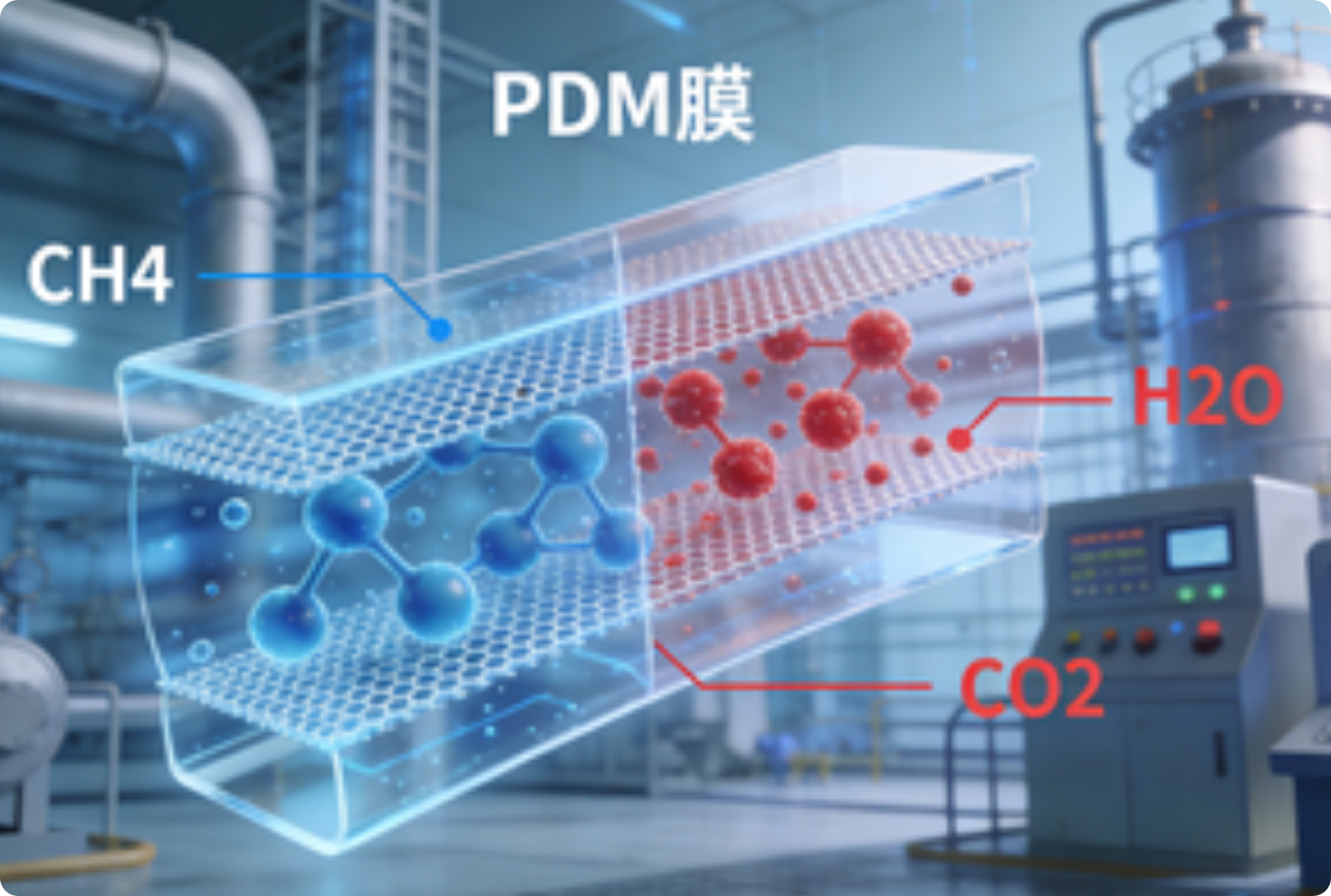
Deep Application Analysis of PDMS Membranes in Natural Gas Purification
The siloxane backbone structure of PDMS membranes offers two core compatibility advantages:
- Selective permeation mechanism: Non-polar siloxane chains have significantly higher dissolution-diffusion capacity for polar molecules (CO₂, H₂S, H₂O) than for non-polar CH₄, achieving a separation effect of “impurities preferentially permeate, CH₄ is retained”.
- Contamination resistance and stability: It has acid resistance (tolerant to H₂S corrosion) and moisture resistance (does not degrade in the presence of water), making it suitable for harsh feed gas environments with high humidity and acidic gases.
Note: 1 GPU = 1×10⁻⁶ cm³(STP)·cm/(cm²·s·cmHg). Higher permeation flux indicates stronger processing capacity per unit membrane area.
In industry, PDMS membranes are usually configured in a multi-stage membrane separation system (2–3 stages) combined with the traditional amine absorption method, forming a hybrid process of “membrane pre-separation + amine fine treatment”. Its advantages are as follows:
- Pretreatment stage: The PDMS membrane first reduces the CO₂ content of the feed gas from 15–25% to 5–8% and H₂S to 100–500 ppm, significantly lowering the load on the subsequent amine absorption tower.
- Simultaneous dehydration: During membrane separation, moisture permeates through the membrane module together with CO₂ and H₂S, eliminating the need for additional dehydration equipment (e.g., triethylene glycol dehydration tower) and simplifying the process flow.
- Energy consumption optimization: The hybrid process reduces energy consumption by 25–35% and capital expenditure by 15–20% compared with the pure amine method, making it particularly suitable for shale gas fields in remote areas (where amine transportation costs are high).
- Project Background: A shale gas field in Texas with feed gas containing 18% CO₂, 1.2% H₂S, and a daily natural gas output of 5 million cubic meters.
- Membrane System Configuration: Adopted PDMS hollow fiber membrane modules (total membrane area: 20,000 m²) with a 2-stage separation design.
- Treatment Effect: The purified natural gas has a CO₂ content of 1.8%, H₂S content of 3.2 ppm, and a water dew point of -15℃, fully meeting pipeline transmission standards.
- Operation Data: The membrane modules have been in continuous operation for 42 months, with the CO₂/CH₄ separation factor maintained above 14, permeation flux decay rate < 8%, and annual energy cost savings of approximately 1.2 million US dollars.
- Project Background: A coalbed methane field in Shanxi with feed gas containing 22% CO₂, 0.8% H₂S, and associated with large amounts of moisture.
- Technical Scheme: PDMS membrane pre-separation + MDEA amine fine treatment, where the membrane system removes 60% of CO₂ and 80% of H₂S.
- Core Advantages: Solved the problem of solvent degradation caused by high H₂S content in the traditional amine method. The membrane modules have strong sulfur contamination resistance, extending the solvent replacement cycle from 6 months to 18 months and reducing operation and maintenance costs by 40%.
- Integrated high-efficiency separation and dehydration: Eliminates the need for an additional dehydration unit, simultaneously achieving acidic gas removal and deep dehydration, simplifying the process chain.
- Contamination resistance and long lifespan: Resistant to H₂S corrosion and organic contamination (small amounts of hydrocarbon impurities in feed gas do not affect membrane performance), with a continuous operation lifespan 30–50% longer than traditional membranes.
- Low energy consumption and flexible adaptability: Membrane separation is driven solely by the feed gas’s own pressure (no additional pressurization required), with energy consumption only 1/5 that of distillation. Moreover, membrane modules can be modularly expanded to adapt to gas fields of different scales (daily output: 100,000–10,000,000 cubic meters).
- Environmental friendliness: No consumption of chemical agents (e.g., amines, desiccants), avoiding environmental pollution caused by solvent leakage, and meeting green extraction requirements.
- Modified PDMS membranes: By doping nanomaterials such as MOFs (Metal-Organic Frameworks) and graphene, the CO₂/CH₄ separation factor can be increased to 25–30, further improving separation efficiency.
- High-pressure resistant membrane modules: Developing PDMS membrane modules resistant to high pressure (> 15 MPa) to adapt to deep-sea natural gas extraction scenarios (with high wellhead pressure).
- Intelligent operation and maintenance: Combining online membrane flux monitoring technology to realize predictive maintenance of membrane modules and reduce downtime losses.
Dongguan Yusheng Technology Co., Ltd. is specialized in the R&D and production of PDMS membranes, and we also provide customization services for related products. Email:zhengzhen@nqrubber.com