









Special Equipment Scenario Empowerment: Innovative TCF (Industrial Manufacturing Scenario) Solution
Core Innovations
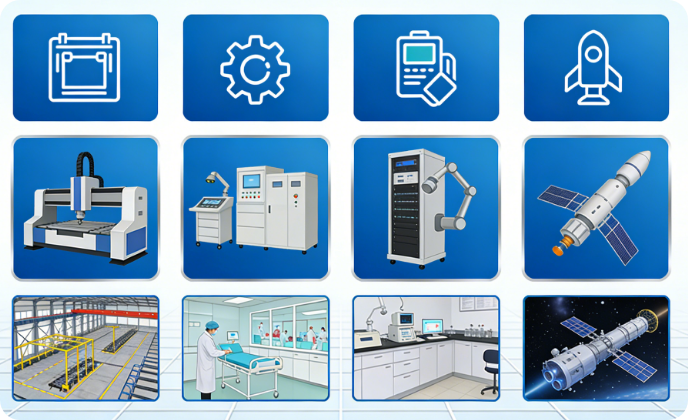
Special Equipment Scenario Empowerment: Innovative TCF
It also delivers full-scenario weatherability including gamma radiation resistance (dose ≥ 100 kGy) and salt spray / chemical corrosion resistance (no damage after 1000-hour immersion in 5% NaCl solution), providing core material solutions for special equipment that integrate transparent conductivity and extreme environmental adaptability.
Differentiating Advantages
-
Solves the service life pain point in extreme environments:
Addressing the industry challenge that conventional TCF suffers rapid conductive performance degradation and short service life under high-low temperature cycles, strong radiation and corrosive environments.
The carbon fiber reinforced skeleton improves structural stability, enabling a service life of over 15 years in polar research equipment (-60℃) and aerospace transparent bulkheads (strong radiation, drastic temperature changes) — more than 3 times longer than conventional TCF.
-
Full-dimensional high weatherability:
Wide-temperature adaptation covers polar cold, desert heat, aerospace vacuum and temperature difference extremes.
- Resistance change rate after 24-hour freezing at -60℃; performance retention rate after 1000-hour aging at 150℃ > 95%
- Gamma radiation resistance up to 100 kGy, meeting aerospace-grade radiation requirements
- Anti-corrosion coating resists marine salt spray and industrial chemical media, suitable for harsh scenarios such as islands and chemical plants.
-
Exclusive adaptation for special equipment:
Balances core transparent conductivity and strict installation requirements of special equipment:
- Light transmittance ≥ 82%, sheet resistance ≤ 30 Ω/□
- Can be directly bonded to transparent cabins and observation windows without affecting visibility
- Excellent mechanical strength (tensile strength ≥ 150 MPa)
- Impact and vibration resistance comply with military / aerospace equipment standards.
Technical Support
-
Reinforced structural design:
Drawing on the extreme environment adaption design logic of forklifts, a three-dimensional carbon fiber woven skeleton is introduced.
The TCO layer (optimized AZO/ITO composite system) is uniformly deposited on the skeleton via magnetron sputtering, forming a stable structure of rigid support + flexible conduction and preventing film delamination or cracking caused by thermal cycling.
-
Process upgrading and optimization:
Magnetron sputtering replaces traditional CVD. Under high vacuum (vacuum degree ≤ 5×10⁻⁴ Pa), the TCO film is densely deposited, with film density increased by 40% and significantly enhanced weatherability.
Plasma pretreatment improves adhesion between TCO layer, carbon fiber skeleton and anti-corrosion coating, with 180° peel strength ≥ 0.8 N/mm.
-
Weather-resistant coating technology:
The surface is coated with a composite anti-corrosion coating of fluorosilane and nano-titanium dioxide, forming a dense hydrophobic and antifouling interface (water contact angle ≥ 110°).
It resists chemical corrosion and reduces dust, frost and ice adhesion in extreme environments, ensuring stable light transmittance and conductivity.
Specializes in R&D, development and manufacturing of transparent conductive films and supporting adhesives.
E-mail: zhengzhen@nqrubber.com
Mobile: +86-13243809168
Zheng Zhen