











Neuro-Interactive Bionic Electronic Skin: Research Report on Transformative Technology in the Field of Disability Assistance
2026/04/30
0
I. Introduction
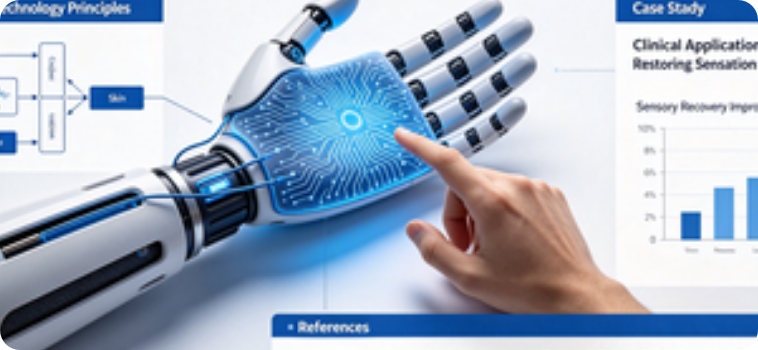
Neuro-Interactive Bionic Electronic Skin
1.1 Research Background
Globally, the disabled population is substantial. Individuals with physical disabilities face numerous challenges such as limited mobility and difficulties in daily self-care, creating an urgent demand for assistive technologies that can improve their quality of life and enhance physical functions. While traditional prosthetics enable amputees to recover partial limb functions to a certain extent, they have prominent deficiencies in sensory perception and control precision, failing to meet patients’ needs for natural, flexible movement and authentic tactile feedback.
As an emerging technology in disability assistance, neuro-interactive bionic electronic skin comes into being against a critical research backdrop and growing development demands. In-depth research by neuroscience on the signal transmission mechanisms of the human nervous system has laid a theoretical foundation for developing devices that directly interface with neural signals. Continuous breakthroughs in new flexible and wearable materials within materials science have made it feasible to fabricate electronic skin that fits the human body of people with disabilities and boasts excellent biocompatibility. Meanwhile, the rapid advancement of electronic technology and Micro-Electro-Mechanical Systems (MEMS) allows high-sensitivity sensors and miniaturized signal processing circuits to be integrated into electronic skin, enabling efficient capture and processing of neural signals. By directly connecting to neural signals to form a closed loop of mind control + tactile feedback, this technology is poised to revolutionize disability assistance. It delivers more natural and precise motor control for people with disabilities and restores their tactile perception of the world, holding immeasurable significance for improving their quality of life and promoting social inclusion.
1.2 Research Objectives and Methods
This study aims to comprehensively analyze the application potential, technical principles, development status and existing challenges of neuro-interactive bionic electronic skin in disability assistance, so as to provide systematic and comprehensive references for the further optimization and large-scale application of this technology.
Multiple research methods are adopted in this study to achieve the above objectives. The literature research method is used to collect, collate and analyze domestic and overseas academic papers, patent documents, research reports and other relevant materials, so as to clarify the development history, current progress and cutting-edge trends of the technology, summarize the achievements and shortcomings of existing studies, and establish a solid theoretical foundation. The case analysis method is applied to conduct an in-depth investigation on practical application cases of neuro-interactive bionic electronic skin, including clinical trials and commercial product applications, to summarize technical effects, user feedback and practical limitations from real-world scenarios. Combined with expert interviews, in-depth exchanges are conducted with scientific researchers, clinicians and engineers in this field to obtain professional insights and practical experience in technological R&D, clinical application and product design, and to explore industry trends and challenges from multiple perspectives. In addition, a combined qualitative and quantitative research approach is adopted: quantitative analysis is performed on technical performance indicators and user experience data with statistical tools to reveal underlying patterns, while qualitative elaboration is conducted on technical mechanisms, application scenarios and social impacts, ensuring a comprehensive, in-depth and scientific research outcome.
II. Overview of Neuro-Interactive Bionic Electronic Skin
2.1 Definition and Principles
Neuro-interactive bionic electronic skin is an innovative disability assistive device integrating cutting-edge achievements in neuroscience, materials science, electronic engineering and other disciplines. It is designed to mimic the tactile perception functions of human skin. By directly interfacing with human neural signals, it realizes accurate perception of external environmental information and natural control of limb movements, constructing a complete closed loop of mind control + tactile feedback. This allows amputees to operate prosthetics just like natural limbs, greatly improving the functionality of prosthetic devices and users’ experience.
Its working principle is based on the signal transmission mechanism of the human nervous system. When an amputee generates motor intentions, the brain emits nerve impulses that transmit along the nerve fibers of the residual limb. Attached closely to the residual limb, the flexible electrodes of neuro-interactive bionic electronic skin capture these weak neural impulses, convert them into electrical signals, and transmit the data to the signal processing unit. With sophisticated algorithms, the processing unit analyzes, decodes and converts electrical signals to identify motor commands such as grasping and bending, and outputs corresponding control signals to drive the prosthetic limb to perform precise movements.
When the prosthetic comes into contact with objects, pressure, temperature and other sensors embedded on the surface of the bionic electronic skin are activated. These sensors sensitively detect physical properties including pressure intensity and temperature changes, and convert physical stimuli into electrical signals. After encoding and secondary conversion by the signal processing unit, the signals are modulated into micro-current pulses matching the characteristics of human neural signals. Delivered reversely to the residual limb nerves via flexible electrodes, these micro-currents stimulate nerve tissues to generate new impulses, which are transmitted to the brain through neural pathways. This enables patients to perceive tactile information such as hardness, softness, cold and heat of objects, thereby realizing real-time tactile feedback.
2.2 Core Differences and Innovations
Compared with traditional disability assistive devices, neuro-interactive bionic electronic skin presents distinct core advantages and innovative breakthroughs in key dimensions.
Traditional prosthetics mostly rely on electromyography (EMG) signal control, which identifies motor intentions by detecting electrical activities of residual limb muscles. However, this method has major limitations: EMG signals are vulnerable to interference from muscle fatigue, skin sweating and other factors, resulting in signal instability and low recognition accuracy. It only supports simple movement control and cannot meet the demands of delicate and complex motions, nor can it provide tactile feedback, leaving users with a numb and unnatural experience when using prosthetics.
Differently, neuro-interactive bionic electronic skin directly interfaces with neural signals, marking its most critical core innovation. Direct capture of nerve impulses delivers higher stability and accuracy than EMG signals, enabling precise recognition of motor intentions and fine control of prosthetic movements. The prosthetic can perform sophisticated tasks such as picking up tiny items and writing, greatly facilitating users’ daily life and work.
Fitting design for residual limbs is another major innovation. Adopting advanced flexible and wearable materials, the electronic skin can closely fit the complex curved surface of residual limbs, ensuring stable and reliable contact between electrodes and nerves to optimize signal capture efficiency and quality. Meanwhile, the high fitness significantly enhances wearing comfort and reduces discomforts caused by ill-fitting traditional prosthetics.
In terms of signal conversion, the technology achieves efficient bidirectional transmission. It forward converts nerve impulses into prosthetic motion commands, and reversely transforms external sensory data into nerve-recognizable micro-currents, forming a complete closed-loop system of mind control and tactile feedback. This bidirectional mechanism allows users to freely control prosthetic movements and real-time perceive interactions with the external environment, restoring authentic sensory and motor functions. The prosthetic thus becomes a natural extension of the human body, substantially enhancing users’ control and overall experience.
III. Technical Analysis of Neuro-Interactive Bionic Electronic Skin
3.2 Flexible Electrodes and Nerve Impulse Capture Technology
The flexible electrodes of neuro-interactive bionic electronic skin adopt a series of advanced and refined technologies to fit residual limbs, capture nerve impulses and convert them into motion commands.
In terms of material selection, flexible electrodes are made of highly biocompatible soft materials such as Polydimethylsiloxane (PDMS) and hydrogels. These materials feature excellent flexibility to fit complex residual limb contours and reduce wearing discomfort, while avoiding rejection reactions with skin and nerve tissues to ensure long-term safety and stability. For instance, hydrogels with high water content possess mechanical properties similar to human tissues, minimizing mechanical irritation to nerves and laying a foundation for stable nerve signal collection.
The electrodes are elaborately designed as microelectrode arrays with customized shapes and dimensions via micro-nano processing technology. With miniature sizes, these microelectrodes can approach nerve fibers more precisely and improve signal detection sensitivity. Some microelectrodes reach the micron scale, capable of penetrating gaps in nerve tissues and making direct contact with nerve fibers to acquire clear and weak nerve impulse signals.
When attached to residual limbs, nerve impulses trigger electrophysiological changes in surrounding nerve tissues and generate weak electrical signals. Flexible electrodes capture these signals through surface electrode sites and transmit data to the processing unit via wires. Shielding technology is applied to enhance signal accuracy and anti-interference capability: metal shielding layers are wrapped around transmission wires to block electromagnetic interference and guarantee pure and stable signal transmission.
The signal processing unit leverages sophisticated algorithms to analyze, decode and convert collected nerve signals. Based in-depth research on neural signal characteristics, combined with pattern recognition and machine learning technologies, the algorithms accurately identify motor intentions and convert them into control outputs for precise prosthetic operation. By training with massive neural signal datasets, a mapping model between motor intentions and neural features is established, enabling rapid and accurate judgment of user demands and generation of corresponding control commands.
3.2 Pressure & Temperature Sensing and Reverse Conversion Technology
The process of perceiving pressure and temperature signals and converting them into nerve-recognizable micro-currents involves multiple core technical links.
Pressure sensing is mainly based on physical mechanisms including the piezoresistive effect and capacitive effect. Piezoresistive sensors are fabricated with flexible conductive materials such as carbon nanotubes and graphene. Under pressure, internal conductive pathways change and cause resistance variation, and pressure intensity can be calculated by measuring resistance changes. For capacitive sensors, pressure alters the distance between electrodes or the dielectric constant, leading to capacitance changes for pressure detection.
Temperature sensing primarily relies on the thermoelectric effect and thermistor effect. Thermoelectric sensors consist of two dissimilar metals or semiconductors; temperature fluctuations at contact points generate potential differences for temperature measurement. Thermistor sensors adopt temperature-sensitive materials whose resistance changes with temperature, such as Negative Temperature Coefficient (NTC) thermistors with resistance decreasing as temperature rises, achieving accurate temperature monitoring.
After capturing physical stimuli, sensors convert pressure and temperature information into electrical signals, which are then amplified, filtered and optimized by signal conditioning circuits to eliminate noise and improve signal quality. The processed signals are encoded and modulated into micro-current signals matching human neural characteristics, which are transmitted back to residual limb nerves via flexible electrodes to trigger nerve impulses and deliver tactile feedback to the brain. By simulating the frequency, amplitude, pulse width and other features of natural neural signals, the system realizes highly simulated tactile perception of softness, hardness, cold and heat.
3.3 Key Technical Difficulties and Solutions
The realization of the closed-loop mind control + tactile feedback function faces multiple technical bottlenecks.
Signal interference is a prominent challenge. External electromagnetic radiation from electronic equipment and human bioelectrical noise may distort nerve impulse signals and reduce recognition accuracy. Environmental changes such as temperature and humidity also interfere with pressure and temperature sensing. To address this issue, multi-layered anti-interference solutions are adopted: hardware shielding with metal and electromagnetic shielding materials isolates external interference, while digital filtering and adaptive filtering algorithms are applied in signal processing to denoise and extract effective signals.
Conversion precision is another critical difficulty. High-accuracy bidirectional signal conversion is required for both nerve impulse decoding and sensory signal reverse modulation. However, individual differences in neural features, limited sensor precision and algorithm constraints restrict conversion accuracy. To tackle this problem, sensor design and manufacturing processes are optimized to enhance sensitivity, stability and linearity. Meanwhile, big data and deep learning technologies are utilized to train multi-scenario signal datasets, establishing adaptive conversion models to accommodate individual differences and dynamic neural changes.
Long-term stability is also indispensable for long-term wearable devices. Material aging, unstable electrode-nerve contact and circuit reliability degradation may lead to performance attenuation in long-term use. Targeted solutions include the adoption of anti-aging durable materials, optimized electrode contact structures for sustained stable signal transmission, and regular equipment detection, calibration and maintenance to ensure long-term and stable operation.
IV. Application Case Analysis in Disability Assistance
4.1 Case of Upper Limb Amputees
Patient No.1, a middle-aged male with above-elbow right arm amputation caused by work-related injury, has experienced tremendous improvements in daily life after using a prosthetic integrated with neuro-interactive bionic electronic skin. Daily grasping movements, once extremely difficult, have become effortless and natural. To pick up a cup on the table, he only needs to generate a grasping intention in his mind. The electronic skin instantly captures nerve impulses from the residual limb, converts them into precise control commands, and drives the prosthetic to hold the cup with moderate force, avoiding crushing or slipping risks.
He can also complete delicate movements such as writing through mind control, which was nearly impossible with traditional prosthetics. With the support of bionic electronic skin, he can flexibly control the pen tip to write smoothly. Though less fluent than before the injury, the handwriting fully meets daily recording needs.
Most importantly, he has regained tactile perception. When touching objects of different textures such as soft towels and hard wood boards, the sensors on the electronic skin convert physical stimuli into adaptive micro-currents and transmit them to the brain. He can clearly distinguish the hardness, temperature and texture of items, enabling authentic interactions with the external world and greatly boosting life satisfaction and self-confidence.
4.2 Case of Lower Limb Amputees
Patient No.2, a young female with below-knee left leg amputation due to a traffic accident, has achieved remarkable improvements in walking and standing ability with prosthetics equipped with neuro-interactive bionic electronic skin. During walking, the electronic skin real-time detects pressure changes between the prosthetic and the ground and feeds back sensory signals to the nerves. When walking on slopes, pressure distribution changes are accurately captured and converted into neural feedback, allowing her to perceive terrain variations, adjust body balance and steps, and walk stably to prevent falls.
In standing scenarios, the bionic electronic skin provides realistic tactile feedback for accurate perception of foot-ground contact, enhancing standing stability. She previously suffered from unsteady standing and anxiety due to insufficient sensory feedback from traditional prosthetics, but can now stand for extended periods with confidence and participate in social activities including gatherings and performances.
Additionally, the technology enables better prosthetic control during daily activities such as slow walking and stair climbing, improving mobility and flexibility. She has regained freedom and joy in life and achieved better social integration.
4.3 Application Effect Evaluation and User Feedback
Based on follow-up investigations and data analysis of multiple disabled users, objective data demonstrates significant improvements after adopting this technology: the average score of daily self-care ability of upper limb amputees increased by [X]%, with the proportion of users capable of independent dressing, feeding and washing rising from [X]% to [X]%. For lower limb amputees, walking stability improved by [X]%, the fall rate decreased by [X]%, and average walking speed increased by [X]%.
In terms of subjective user feedback, the technology has received widespread high recognition. Users reported that restored tactile feedback bridges the sensory gap with the external world, eliminating the numb feeling caused by traditional prosthetics and greatly enhancing psychological well-being and self-esteem. One upper limb amputee commented: “This neural bionic electronic skin prosthetic lets me regain part of my body and perceive the world like healthy people. It is life-changing and reignites my hope for life.” Lower limb amputees also stated that movement has become more natural and relaxed, freeing them from mobility restrictions and achieving a qualitative leap in quality of life.
Relevant data and feedback fully prove that neuro-interactive bionic electronic skin delivers outstanding effects in improving the self-care ability and life quality of people with disabilities, with broad application prospects and promotion value.
V. Market Status and Development Trends
5.1 Market Scale and Competitive Landscape
Currently, the neuro-interactive bionic electronic skin industry is in the early development stage of the disability assistance market, yet it shows robust growth momentum. According to QYResearch, the global bionic electronic skin market size reached approximately 120 million US dollars in 2024, and is projected to hit 261 million US dollars by 2031, with a Compound Annual Growth Rate (CAGR) of 10.6% from 2025 to 2031. As a core segmented application in disability assistance, neuro-interactive bionic electronic skin is expanding steadily with technological maturity and growing application cases.
Globally, numerous enterprises and research institutions are engaged in the R&D and production of neuro-interactive bionic electronic skin. Internationally, leading medical technology enterprises and university research teams dominate the field with profound accumulation in neuroscience and electronic engineering. Domestically, Chinese enterprises and research institutes are actively deploying this track. For example, Canest Technology under Hanwei Technology has over ten years of research and development in flexible sensors, cooperating with nearly 20 robot manufacturers. Its multi-modal electronic skin modules support force and temperature sensing and have formed solid technical advantages. Research teams from Tsinghua University, Northeastern University and other key universities have made breakthroughs in material innovation and signal processing algorithms, providing strong technical support for industrial development. Overall, the market remains fragmented without monopolistic players, featuring fierce competition and extensive industrial cooperation.
5.2 Driving Factors and Challenges
The rapid development of the neuro-interactive bionic electronic skin market is driven by multiple factors. Technological integration of neuroscience, materials science and electronic engineering continuously spawns innovative achievements. The R&D of new flexible, wearable and biocompatible materials optimizes fitting performance and signal stability, while iterative upgrading of signal processing algorithms improves neural recognition accuracy and motion control precision.
Growing social demand is another core driver. The huge global disabled population has strong demands for functional recovery and life quality improvement. Rising social attention to vulnerable groups, increased investment in disability assistive technologies, and favorable government policies and funding support have further accelerated the industrialization process.
Nevertheless, the industry still faces prominent challenges. High R&D and production costs caused by high-end materials, precision manufacturing and complex signal systems restrict large-scale popularization. Technical bottlenecks including long-term biocompatibility, signal attenuation and inflammation risks need to be further broken through. In addition, low market awareness and insufficient science popularization limit the acceptance and penetration of this emerging technology among disabled groups.
5.3 Forecast of Future Development Trends
Driven by technological innovation and market demand, neuro-interactive bionic electronic skin will achieve comprehensive breakthroughs in multiple dimensions in the future. In terms of material technology, new flexible, biodegradable and self-healing bionic materials will be developed to enhance biocompatibility, reduce biological risks and extend service life. With the in-depth integration of artificial intelligence and machine learning, signal processing systems will become more intelligent and accurate, supporting the control of more complex and delicate limb movements.
In terms of market expansion, application scenarios will be further diversified. Beyond upper and lower limb amputees, customized solutions will be developed for patients with spinal cord injuries, congenital hand malformations and other special groups to meet differentiated needs. With cost reduction and technological maturity, market penetration will expand from developed countries to emerging economies. Moreover, cross-product integration with smart wheelchairs, artificial eyes and other assistive devices will be realized to build an all-round intelligent disability assistance system and facilitate better social inclusion.
VI. Conclusion and Prospects
6.1 Research Conclusions
With the core advantage of direct neural signal docking and closed-loop mind control and tactile feedback, neuro-interactive bionic electronic skin possesses unique technical value in disability assistance. By capturing nerve impulses through flexible residual limb electrodes to drive prosthetic movements and converting external sensory stimuli into recognizable neural micro-currents for tactile restoration, the technology effectively improves control precision and sensory authenticity of prosthetics.
Application cases verify its outstanding practical effects: it significantly enhances daily self-care and fine motor abilities of upper limb amputees, and improves walking stability, balance and mobility of lower limb amputees. At the market level, despite being in the initial stage, the industry presents steady expansion potential and will become a core technical pillar of the global disability assistance sector in the future.
6.2 Potential Impacts and Social Value in Disability Assistance
Neuro-interactive bionic electronic skin exerts far-reaching impacts on the disability assistance industry. In terms of technological innovation, it provides an upgrading direction for traditional assistive devices, promoting the intelligent, precise and humanized transformation of the entire industry and forming a virtuous cycle of technological innovation.
For individuals with disabilities, the technology enhances self-care ability and independent mobility, helping them participate in social activities with greater confidence and dignity, reduce dependence on others, and improve mental health and overall well-being.
From a social perspective, the large-scale application of this technology promotes inclusive social development, narrows the life gap between disabled and able-bodied groups, and fosters a more harmonious, equal and inclusive social atmosphere. It also embodies social care for the disabled and the positive value of technological progress for human welfare, delivering important social demonstration significance.
6.3 Research Limitations and Future Research Recommendations
This study conducts a comprehensive analysis of neuro-interactive bionic electronic skin, yet certain limitations remain. Restricted by limited application cases, the research sample size is insufficient, leading to partial limitations in effect evaluation and failure to fully reflect individual and scenario-based technical differences. In addition, the in-depth exploration of complex signal processing algorithms and long-term stability mechanisms is inadequate, leaving room for further technical optimization.
Future research can be carried out in the following directions: First, expand the scope of application case studies, collect multi-scenario and multi-group data, and adopt big data analysis to summarize technical advantages and defects for targeted optimization. Second, strengthen interdisciplinary research in materials science, neuroscience and electronic engineering to improve neural compatibility, signal conversion precision and long-term device stability. Third, promote the formulation of industrial technical standards and quality evaluation systems to regulate standardized production and healthy market development. Meanwhile, cross-disciplinary cooperation should be strengthened to accelerate technological transformation and industrial popularization, enabling neuro-interactive bionic electronic skin to better benefit people with disabilities.