











Optical UV-Curable Silicone
2026/03/25
0
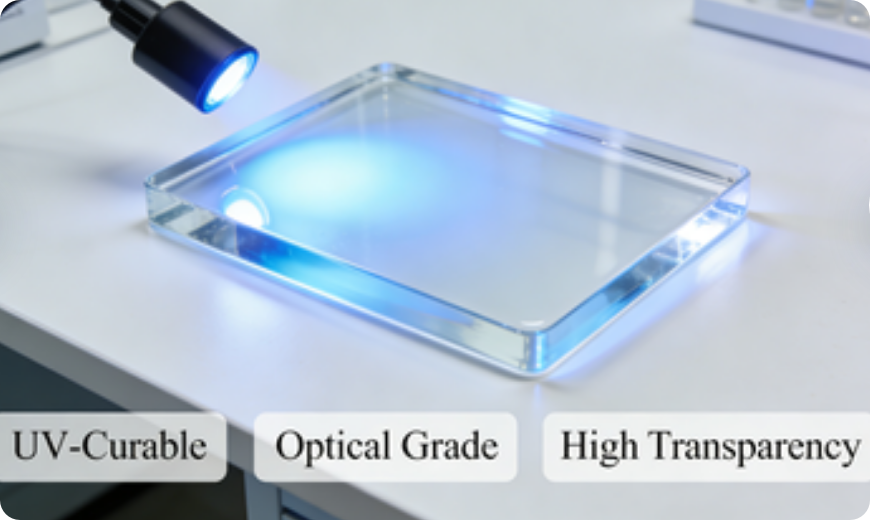
Optical UV-curable silicone is a special polymer material that combines the excellent properties of silicone with the high-efficiency and energy-saving advantages of UV curing technology. Its chemical name is often referred to as UV-curable polysiloxane. It is mainly used in applications with stringent requirements for optical performance, curing efficiency, and environmental adaptability, making it one of the key basic materials in the fields of optics, electronics, and advanced materials. Its properties can be precisely tuned through molecular design to meet various high-end application needs.
I. Core Structure and Performance Characteristics
(I) Core Structure
Optical UV-curable silicone consists of two structural components that synergistically endow the material with unique properties:
- A silicone backbone with Si-O bonds as the main chain, with a bond energy as high as 1014.12 kJ/mol, much higher than C-C and C-O bonds, providing stable fundamental properties.
- Photoactive functional groups grafted onto silicon atoms, commonly including acrylate, epoxy, thiol, etc., which enable UV responsiveness and allow rapid curing under specific UV wavelengths.
For example, the introduction of 3-methacryloxypropyltrimethoxysilane enables the resin to undergo free-radical crosslinking under 385 nm UV-LED irradiation, forming a stable 3D network structure.
(II) Key Performance Advantages
Optical UV-curable silicone integrates the dual advantages of silicone and UV curing technology, especially outstanding in optical performance:
-
Excellent optical performance: Light transmittance reaches over 92%, with some high-end products exceeding 99%. Refractive index is tunable via molecular design (typically ~1.407, over 1.5 for premium grades). It has exceptional yellowing resistance with ΔYI < 0.1, maintaining long-term optical clarity for optical devices.
-
High-efficiency curing: Cures within seconds to tens of seconds under UV light (365 nm, 385 nm commonly used) without high-temperature heating. Curing efficiency is 5–10 times that of traditional thermally cured silicone, with only 1/5 the energy consumption, greatly improving productivity and complying with green energy-saving trends.
-
Extreme environmental resistance: Outstanding high-temperature resistance (short-term 300 °C, thermal decomposition temperature up to 400 °C) and low-temperature resistance (structural integrity from -180 °C to 250 °C). Also resistant to acid/alkali (pH 1–14), salt spray (>500 hours), UV, and ozone aging, suitable for harsh working environments.
-
Low shrinkage & high dimensional accuracy: Volume shrinkage is4.83%**, with optimized formulations achieving near-zero shrinkage. This effectively avoids internal stress during curing, ensuring dimensional accuracy and structural integrity, especially for precision optical components.
-
Eco-friendliness & safety: Mostly solvent-free formulations reduce VOC emissions, complying with EU REACH and other environmental regulations. Some medical-grade products pass ISO 10993 testing with good biocompatibility for medical implant-related applications.
Optical UV-Curable Silicone
II. Curing Mechanism and Key Influencing Factors
(I) Core Curing Mechanism
Curing relies on photoinitiators absorbing UV energy to generate active species, triggering polymerization and crosslinking of photoactive groups, finally forming a 3D network from liquid to solid. Two main pathways:
-
Free-radical curing: Uses free-radical photoinitiators (e.g., benzophenone derivatives) to generate active radicals under UV, triggering acrylate double-bond polymerization. Fast reaction but prone to oxygen inhibition on the surface. Solutions include nitrogen purging, oxygen-barrier coatings, or oxygen-inhibition-resistant resins (e.g., silicone acrylate oligomers).
-
Cationic curing: Uses cationic photoinitiators (iodonium salts, triarylsulfonium salts) to generate cationic active species, triggering epoxy ring-opening polymerization. Advantages: no oxygen inhibition, extremely low shrinkage. Sensitive to humidity, ideal for high-precision applications.
Additionally, thiol-ene click chemistry enables fast, oxygen-insensitive curing while preserving excellent mechanical and chemical properties. Traditional thermally cured silicone (e.g., Sylgard 184) can be converted to UV-curable grades via simple modification.
(II) Key Influencing Factors
-
UV parameters: Wavelength, intensity, and exposure time directly determine curing efficiency. Epoxy groups favor 365 nm; acrylates favor 385 nm. Insufficient intensity or time leads to incomplete curing.
-
Photoinitiator: Type and dosage are critical. Insufficient dosage causes slow/incomplete curing; excess may cause cage effect (reducing conversion) and lower optical transparency. Optimal dosage is typically around 2 wt%.
-
Molecular structure design: Siloxane chain length, pendant groups, and crosslink density control hardness (Shore A 20–90), transmittance, refractive index. Phenyl groups increase refractive index and heat resistance; methyl groups reduce surface tension and improve antifouling.
-
Environmental factors: Oxygen inhibits free-radical surface curing; humidity destabilizes cationic curing. Controlled atmosphere is often required for high-quality curing.
III. Main Classifications and Preparation Methods
(I) Main Classifications
By photoactive functional group, five major categories:
-
Acrylated polysiloxane: Most widely used and researched. High reactivity, fast curing, good stability, adjustable viscosity, partial oxygen-inhibition resistance. Used in optical coatings and adhesives.
-
Epoxy-functionalized polysiloxane: Extremely low (near-zero) shrinkage in cationic polymerization, dominant for ultra-high-precision optical components.
-
Vinyl ether-functionalized polysiloxane: High reactivity, low toxicity, low odor, compatible with free-radical, cationic, and hybrid systems. Limited by high raw material cost.
-
Thiol-ene functionalized polysiloxane: Fast UV response, oxygen-insensitive, flexible elastic films. Limited by strong thiol odor and poor storage stability.
-
Styryl polysiloxane: Low-cost, good copolymerizability, improves hardness and strength. Limited by high volatility, slow reaction, and relatively poor curing performance.
(II) Main Preparation Methods
Core: graft photoactive groups onto silicone main chain.
-
Sol-gel method: Uses polymethyltriethoxysilane (PTS), γ-methacryloxypropyltrimethoxysilane (KH-570), etc., in solvents (ethanol, toluene) with catalysts (HCl, ammonia). Hydrolysis and condensation form sol, then cure. Simple, low-cost, suitable for mass production.
-
Hydrosilylation: Reacts Si-H-containing polysiloxane with unsaturated compounds (vinyl, acrylate) under Pt catalyst. Mild conditions, high purity, precisely controllable structure. Mainstream for high-performance optical UV-curable silicone.
-
Modification conversion: Converts conventional thermally cured silicone (e.g., Sylgard 184) to UV-curable grade using commercial reagents. Simple process, suitable for lab and small-scale customized production.
IV. Core Application Fields
(I) Optical Devices
-
Mini-LED/LED packaging: High transmittance, anti-yellowing, heat-resistant. High-end grades (e.g., SPASR resin) cure in <30 s, shrinkage <4.83%, maintaining ~91% luminance after 168 h 85℃/85%RH aging. Also used for LED lenses and light guides.
-
Optical fiber coatings: Moderate viscosity (2000–5000 cps), fast curing (≥1500 m/min), low refractive index (<1.40), excellent mechanical properties. Reduces microbending loss, critical for fiber lasers.
-
Precision optical components: Bonding and sealing of lenses, prisms, filters. Low shrinkage ensures accuracy; high transparency and aging resistance suit cameras, microscopes, lithography machines.
(II) Electronic and Electrical Applications
-
Electronic encapsulation & potting: Excellent electrical insulation, thermal stability, and sealing. Protects ICs, chips, and components from moisture, dust, and impact while enabling high-speed assembly.
-
UV-curable adhesives: Surface dry in seconds, flexible and impact-resistant, reduces stress cracking. Ideal for high-takt electronic assembly and optical bonding.
(III) Other High-End Fields
-
Medical: Medical-grade biocompatible grades for surface modification and bonding of catheters, implants, avoiding rejection. Solvent-free meets medical environmental standards.
-
Aerospace: Atomic-oxygen-resistant silicone epoxy composites for satellite thermal insulation, maintaining integrity under extreme temperature differences.
-
Coatings & inks: Eco-friendly UV-curable coatings for construction and woodware (weatherable, antifouling, heat-resistant); high-hardness, wear-resistant UV-curable inks for packaging and label printing.
V. Technical Bottlenecks and Development Trends
(I) Current Technical Bottlenecks
-
Performance trade-offs: Difficulty balancing high refractive index vs. low shrinkage, high hardness vs. high flexibility. Phenyl incorporation increases brittleness; low shrinkage may reduce speed and adhesion.
-
Cost & process constraints: High-cost high-performance photoinitiators and specialty monomers; expensive precision coating equipment for optical fiber and Mini-LED limits widespread adoption.
-
Insufficient environmental adaptability: Cationic systems humidity-sensitive; free-radical systems suffer oxygen inhibition. Some products still yellow or degrade under extreme heat/prolonged UV.
(II) Future Development Trends
-
High-performance: Develop grades with refractive index >1.5, shrinkage <3%, ultra-low yellowing, and high adhesion for Mini-LED and high-end lenses (e.g., advanced SPASR resins).
-
Eco-friendly & low-cost: Solvent-free, low-VOC, low-odor formulations; cost reduction for initiators and monomers; simplified processes and scaled production.
-
Functional diversification: Multifunctional composites with thermal conductivity, electrical conductivity, antibacterial properties, etc. Wavelength-adaptable materials for UV-LED compatibility.
-
Process refinement: Precision coating and curing for micro-optics and microelectronics; industry-academia-research collaboration to accelerate lab-to-fab translation.